If you’ve ground hours in Need for Speed, binged Tokyo Drift, or burned your retinas cruising the digital asphalt of Assetto Corsa, you probably think you understand Daikoku. You don’t. Not really. It’s not just a parking lot—it’s a cathedral of concrete where the religion is high-octane gasoline and the hymns are screamed by turbochargers.
Located smack in the middle of Yokohama harbor, the place feels like a glitch. A matrix error. A highway rest stop that somehow mutated into the epicenter of the global car underworld. You see everything. R34 GT-Rs parked cheek-to-jowl with slammed Lamborghinis. Kei trucks rocking neon underglow that hurts your eyes. It’s chaotic. Loud. Smells like unburnt fuel and salty sea air. There are no tickets. No gatekeepers. It’s organic, messy, and totally accident. That’s the magic.
Where is Daikoku Parking Area Located?
It’s on an island. Artificial, man-made stuff. Daikoku Futo is the island, and the Parking Area (PA) sits directly beneath the spiraling, dizzying ramps of the Shuto Expressway. Part of the Bayshore Route—the Wangan.
You can’t miss it if you’re driving, but you can’t exactly stumble onto it either. You have to be on the toll road. It’s ringed by warehouse districts and shipping containers—gives it this gritty, industrial aesthetic that looks perfect at 2 AM under the harsh sodium lights. The highway loop overhead acts like a massive echo chamber. When a Supra hits redline up there, the sound crashes down into the lot like physical thunder.

Does the Daikoku Car Meet Happen Every Night?
Sort of. Maybe. Not really. There are almost always cool cars at Daikoku, even on a random Tuesday at 3 AM when normal people are sleeping. But the “Meet”—the monster you see on Instagram—that’s not every night.
Weeknights are chill. You might see a few locals grabbing canned coffee, maybe a drift car or two passing through on a test run. It’s quiet. You can actually talk to owners without screaming. But if you want the madness? The sensory assault? You gotta time it right.
Best Times to Visit: Weekends vs. Weeknights
Friday and Saturday nights. That’s the window. From maybe 8 PM to midnight. This is when the freaks come out. The sound system vans, the Liberty Walk crews, the guys pretending they’re in a racing manga. It gets packed. Suffocatingly packed.
Sunday mornings are a total vibe shift. From 7 AM to noon, the crowd changes. Old money. Vintage Ferraris, pristine NSXs, elderly Japanese guys in driving gloves polishing Lotus Europas with diapers. It’s civilized.
I honestly prefer Sunday mornings sometimes. Less drama with the cops. Better light for photos. But if you need that Tokyo Drift fantasy, you have to brave the Friday night hellscape.

The Tribes of Daikoku: Decoding the Subcultures
Step into the lot on a Friday and it looks like a mess. A beautiful disaster. But to a trained eye, it’s a highly organized ecosystem of tribes. You need to know what you’re looking at.
The Bosozoku & Kaido Racers
You hear them before you see them. Descendants of 70s biker gangs. Their cars are loud, obnoxious, and fascinating. Look for “Takeyari” pipes—bamboo-spear exhausts sticking six feet in the air. They rev engines in a rhythmic, musical pattern called bubu-call. It’s not about speed—it’s about being impossible to ignore.
The Itasha
Translates to “Painful Car”—because it hurts to look at, or maybe hurts your wallet. Cars wrapped in full-body anime liveries. Don’t let the cute cartoon girls fool you; the car underneath is often a 600-horsepower weapon. The ultimate collision of Otaku obsession and horsepower.
The VIP (Bippu) Style
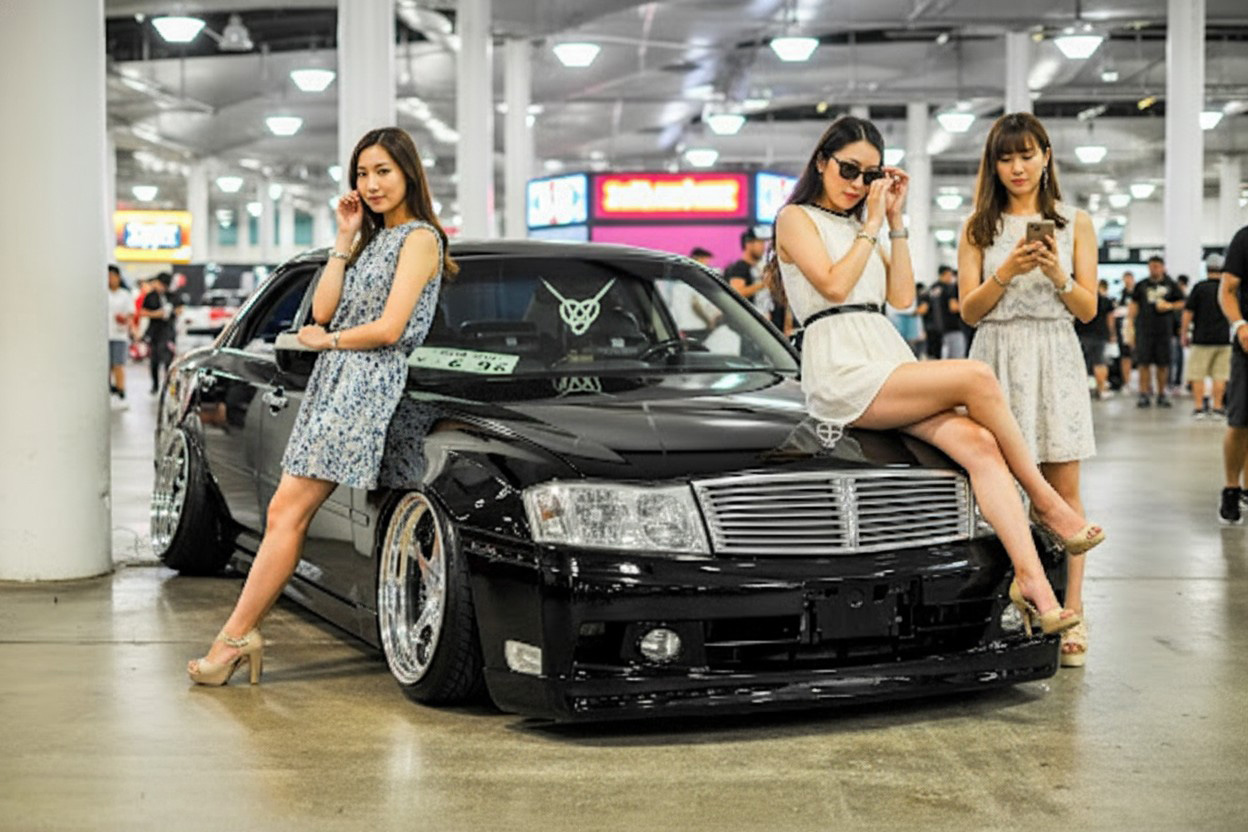
Usually black. Big sedans—Toyota Crowns, Lexus LS. Slammed to the pavement. Originated with the Yakuza, allegedly, who needed cars that looked domestic to cops but were living rooms inside. Now it’s about “stance”—negative camber and chrome. They park in the back. They look menacing.
The Vanning Crews
Japan has a weird obsession with vans. Toyota HiAces modded to look like spaceships, draped in neon, massive fiberglass wings, sound systems that could blow out a stadium’s windows. People call them “Batman” vans because of the dark, winged look.
Ghosts of the Wangan: The History of the Mid Night Club
You can’t talk Daikoku without mentioning the ghosts. In the 80s and 90s, this wasn’t just a parking spot. It was the staging ground for the Mid Night Club.
A real, secret society. To join, your car reportedly had to hit 250km/h (160mph). To stay? You had to sustain 300km/h (190mph) on the Wangan. Strict code of ethics—never endanger the public. You crash into a civilian, you’re out. Immediately.
They became a myth, chasing top speed in Porsches and GT-Rs while Tokyo slept. Disbanded in 1999 after a horrific crash with some bosozoku bikers, but the spirit hangs heavy here. Every time you see a midnight purple R33 idling in the corner, you wonder if the driver was there. Back in the glory days.
Gourmet Trash: The Daikoku Diet
You don’t come for Michelin stars. You just need calories. The culinary scene here is legendary for being convenient and kinda gross in a nostalgic way.
The Lawson inside the PA is probably the most famous convenience store on earth for car people. It’s the lifeline. You grab endless canned Boss Coffee—fuel of the Japanese driver—Onigiri, maybe some Karaage-kun fried chicken.
Then the vending machines. Japan loves them, but highway stops go harder. You can get hot meals dispensed by robots—hamburgers in boxes, hot dogs, takoyaki. Is it good? No. Is it satisfying when it’s 40°F and you’ve been staring at Skylines for three hours? Absolutely.
How to Visit Daikoku PA: Can You Walk There?
No.
Don’t try it. Seriously. Daikoku PA is technically a highway rest stop. Illegal to walk in from the street. Tall fences, and the only way in is via expressway off-ramps. No sidewalks.
I’ve heard stories of tourists trying to jump fences or walk the highway shoulder. Don’t be that guy. It’s dangerous, and the police will arrest you. You need wheels.
Plan B: Where to Go When Daikoku Closes
Police shut it down? Don’t panic. Night isn’t over. The “migration” is part of the ritual. When sirens flare and loudspeakers bark, the swarm moves to one of two spots:
1. Tatsumi No. 1 PA
The “Little Brother.” High up on the C1 loop. Offers that iconic Blade Runner view of the skyline. Much smaller, parking is a nightmare, but this is where serious racers go. Less “parking and chilling,” more “pausing between laps.” Neon-soaked lighting is incredible for photos.
2. Umihotaru PA
You want a journey? Go here. A parking area on an artificial island in the middle of Tokyo Bay. Connects the underwater tunnel to the bridge. Looks like a concrete aircraft carrier. Toll is expensive—¥3000 round trip—which filters out the riff-raff. Windy, cold, spectacular.
Is the Daikoku Car Meet Legal?
Grey area. Parking at a rest stop? Legal. Buying coffee? Legal. Meeting friends? Legal. But holding an “event” without a permit? Not legal.
Since these meets are spontaneous, they technically aren’t events. Just “a lot of people parking at once.” But the line is thin. Someone starts blasting music or doing burnouts, it crosses the line. That’s when trouble starts.
Police Crackdowns and Closures: The “Free Shaken” Risk
The police—police-san—have a weird relationship with this place. They know it’s a landmark. They also hate the noise.
Friday and Saturday nights, if the lot gets too full, they close the entrance. Block ramps with cones. If you’re inside, you stay (usually). Outside? Tough luck.
Warning: Sometimes, they aren’t just closing the lot. They run a crackdown. Locals call it “Free Shaken.” Officers set up a checkpoint at the exit, inspecting every modified car. Wheels stick out? Wing too wide? Exhaust too loud? Ticket on the spot. Or a “red sticker”—illegal to drive until fixed. Nightmare scenario.
The Digital Pilgrimage: Assetto Corsa and the Sim Racers
Half the foreigners at Daikoku these days aren’t just movie fans—they’re sim racers. The Shutoko Revival Project (SRP), a mod for Assetto Corsa, recreated the whole Tokyo expressway network. Daikoku included. Laser-scanned accuracy.

For many, walking into real Daikoku is surreal déjà vu. You’ve driven these ramps virtually a thousand times. You know where the bathroom is before you step foot in Japan. It’s digital culture preserving physical culture. If you see a foreigner crying near the vending machines, probably an SRP player finally seeing the holy land.
The Rules of Daikoku: Etiquette for Spectators
Don’t touch the cars. Obvious, right? You’d be surprised.
Don’t stand in the middle of driving lanes for a photo. You will get run over. Or honked at by an angry trucker hauling fish to Tsukiji.
Be polite. Japanese car culture is built on respect. A simple “Sumimasen” (excuse me) or “Kakkoii desu ne” (It’s cool, isn’t it?) works wonders. And don’t ask if it’s a “real” GT-R. Just admire the thing.
Renting a Car in Japan: Can American Tourists Drive?
Yes. But you need paperwork. Your US license is trash here on its own. You must have an International Driving Permit (IDP).
Get this before you leave the States. Go to AAA. Costs like $20. Show up at the Narita rental counter with just your Texas license? They will laugh at you. Politely, but they’re laughing. And you’ll be walking.
Is it Hard to Drive in Japan for Foreigners?
It’s… an adjustment.
Left side of the road. Turn signal is on the right of the steering wheel. You will hit your wipers every time you try to turn for two days. Rite of passage.
Roads are narrow. Claustrophobic in cities. Highways—like the Shuto—are tight, twisty, confusing. GPS talks too much. But Japanese drivers are predictable. Polite. They don’t drive aggressive like LA or chaotic like Rome. Follow the rules, you’ll be fine.
Navigating the Roads: How to Cross “Borders” and Tolls with a Rental
Japan has no internal borders, but it has toll gates. Everywhere. Expensive, too. Tokyo to Kyoto costs as much in tolls as a bullet train ticket.
Get an ETC card with your rental. Little chip card for the dashboard slot. Lets you breeze through gates (look for purple signs saying ETC) without stopping. Pay the total when you return the car. Without it? You’re fumbling for cash while a line of trucks builds up. Stressful.
The “3-Year Rule” Explained: Why Japanese Cars Are Sold So Quickly
Ever wonder why used JDM engines are so cheap? It’s Shaken.
Mandatory vehicle inspection. Rigorous. Brutal. Buy a new car, you get a 3-year grace period. After that? Inspect every two years.
Costs a fortune—over $1,000 USD easily, plus insurance, weight tax. Tiny oil leak? Torn boot? Fail. Fix it or scrap it.
For many Japanese folks, it’s cheaper to sell the car before the first Shaken and buy new. Keeps the economy moving. Floods the world with quality used cars.
Beyond Cars: Is Hello Kitty Land a Real Place?
Yeah. Sanrio Puroland. In Tama New Town, outskirts of Tokyo.
Entirely indoors. Weirdly disorienting. Feels like a casino for toddlers. Neon, parades, manic music. It’s a trip. If you’re sick of exhaust fumes, go here to smell popcorn and sugar. Polar opposite of JDM culture, but intense in its own way.
Cultural Etiquette: Can I Kiss My Girlfriend in Public in Japan?
You can… but maybe don’t.
Public Displays of Affection (PDA) are looked down on. Holding hands is fine—young couples do it in Harajuku. But making out on the train? Kissing at a crosswalk?
People stare. They won’t say anything—that’s rude—but they are judging you. Hard. Seen as messy. Lack of self-control. Keep the romance for the hotel or karaoke booth.
Safety & Statistics: What is the #1 Cause of Death in Japan?
Cancer. Malignant neoplasms.
People think it’s suicide because of “salaryman” stereotypes. Suicide isn’t even top 5 anymore. Japan is old. Really old. Leading causes are age-related. Cancer, heart disease, senility. First-world mortality profile.
Roads are incredibly safe. Fatal accidents are rare compared to the US. Ironic, considering the street racing history. But that’s Japan—a contradiction wrapped in a mystery, drifting sideways at 100mph.